

Looking to close the execution gap in your organisation?
Explore the full Execution Intelligence™ framework here.
Executive Summary
Most strategies fail beyond the planning phase, in the conversations that follow. Inside many organisations, execution stalls because the questions shaping the decisions that follow the strategy are shallow, vague, and comfortable. These $2 questions signal a deeper issue, a leadership culture operating below its decision depth. This article introduces the Execution Intelligence™ framework and shows how upgrading question quality is one of the fastest ways to accelerate decision-making, strengthen accountability, and close the execution gap between intent and results.
What Is Execution Intelligence™?
Execution Intelligence™ is the ability of a leadership team to consistently convert strategy into action, with speed, clarity, and accountability.
It is not about working harder. It is not about better slide decks or longer planning cycles. It is about the quality of thinking, questioning, and decision-making that happens between the boardroom and the front line.
Execution Intelligence™ operates on a simple premise: the questions your leaders ask every day determine the decisions they make, the culture they build, and the results they produce. Organisations with high Execution Intelligence™ ask sharp, specific, forward-facing questions. Organisations with low Execution Intelligence™ ask vague, comfortable, backward-looking ones.
I developed this framework to help senior teams diagnose and close the gap between strategic intent and organisational execution.
The Global Execution Crisis No One Is Talking About
Here is a number worth sitting with.
According to a global survey reported by Harvard Business Review, only 8% of leaders are rated very effective at both strategy and execution (Source: https://hbr.org/2015/12/only-8-of-leaders-are-good-at-both-strategy-and-execution). McKinsey’s research on transformations has found success rates are consistently low, less than 30% succeed, and highlights how heavily outcomes depend on the execution of change across leadership and the workforce (Source: https://www.mckinsey.com/capabilities/people-and-organizational-performance/our-insights/unlocking-success-in-digital-transformations) Gallup’s research adds another layer: only 22% of employees strongly agree that their organisation’s leadership has a clear direction for the company, that even when a strategy exists, it rarely lands with the clarity needed to drive action (Source: https://www.gallup.com/workplace/247028/leaders-prepare-disruption.aspx)
While it’s easy to think these are planning problems, they’re actually execution culture problems. And at the centre of most execution culture problems is something surprisingly simple: the wrong questions are being asked, in the wrong rooms, by the wrong people. Every single week.
In most organisations, the execution gap is caused by invisible thinking patterns that are deeply embedded in leadership culture. The $2 question is one of the clearest signals that an organisation is operating at a shallow decision depth. It is not just a behavioural habit. It is a systemic pattern, one that compounds quietly until a strategy that looked brilliant on paper becomes another case study in why organisations fail to execute.
What is a $2 Question?
A $2 question is a low-value question asked in a high-value moment.
It is not always asked out of laziness. Sometimes it comes from habit. Sometimes from a fear of saying the wrong thing. Sometimes from a culture that has quietly trained people to stay on the surface. But whatever the cause, the effect is the same: a missed opportunity to create clarity, drive decisions, and move the organisation forward.
$2 questions share four common traits. They are:
- Easily answered elsewhere: A search, a document, or a colleague could resolve them in minutes
- A sign of poor preparation: The person asking has not done the basic groundwork
- A waste of high-value time: They consume moments that could generate real insight
- A signal of shallow thinking: They stay on the surface instead of driving deeper
At an individual level, a $2 question is a minor misstep. At an organisational level, when $2 questions become the default mode of leadership communication, they become a structural drag on execution, decision-making speed, and leadership accountability.
The Story That Illustrates It
During a trip to Thailand for a technology training programme, I had the chance to hear Mechai Viravaidya speak. Known as the “Condom King of Thailand,” Mechai was a former Minister of Health, credited with dramatically curbing the AIDS epidemic through bold public health advocacy. He was named one of the 20 most influential leaders in Asia.
After an inspiring address, Mechai displayed his personal contact details on screen and invited questions from the room.
A man named Ahmed raised his hand.
“Thank you so much for such an amazing presentation, Mr. Viravaidya. How can we get in touch with you?”
The room went silent. The contact details were still on the screen behind him.
Mechai glanced back at the screen, then back at Ahmed. “Call. Email. Send a letter. Pick one, young man,” he said, and moved on.
Ahmed had a rare chance to ask anything he wanted from one of Asia’s most respected leaders. He used it to ask a question the screen had already answered.
That is the $2 question in its purest form. And some version of it is happening inside your organisation right now.
$2 Questions Are Everywhere
These moments are not just conference room embarrassments. They show up across every layer of organisational life:
- A LinkedIn connection opens with “How are you?” and offers nothing further
- A team member asks the Managing Director something the company intranet answers in thirty seconds
- A candidate in a senior job interview asks, “What time is lunch around here?”
- A leader opens a strategy review with “Is everyone aligned?”, and accepts the nods
Each of these is a missed opportunity. And when they become habitual inside a leadership team, they signal something important: the organisation is operating below its decision depth. That gap has a name. It is the execution gap. And it is costing more than most leaders realise.
The Cost of Asking the Wrong Questions
Bad questions are not just inefficient. In larger organisations, they are genuinely expensive.
As a rule of thumb, in a $100M organisation, even a 30-day delay in a key revenue initiative can translate into meaningful opportunity cost. Poor questions do not feel costly in the moment. But at scale, across dozens of meetings, hundreds of decisions, and thousands of leadership interactions each year, they compound into significant financial drag. It’s easy to think of this as a “soft” people problem, but it’s actually a commercial one.
Here are four specific ways that $2 questions damage strategic execution and organisational performance:
Delayed Decisions
When leaders ask the wrong questions, they gather the wrong information. Meetings fill up with discussion that does not move anything forward. Real decisions get pushed to the next meeting, and the one after that. In fast-moving markets, delayed decisions are losses. Every week a leadership team spends asking “Who is responsible for this?” instead of “What does done look like by Friday, and who owns it?” is a week where competitors gain ground. Closing the execution gap requires fast, clear decisions, and those come from sharp, well-targeted questions.
Political Ambiguity
Vague questions produce vague answers. And in large organisations, vague answers become political. Different teams hear the same unclear question and draw different conclusions. Each group defends its own interpretation. Instead of moving forward together, departments drift apart. This internal misalignment is one of the most common, and most avoidable, reasons why strategies fail during implementation. It does not start in the strategy. It starts in the questions that shaped how that strategy was discussed.
Reduced Ownership
Low-value questions often signal one of two things: someone is avoiding accountability, or they are waiting to be told what to do. Neither builds the ownership that drives execution. Strong organisational execution depends on leaders who ask “What can I move forward today?” not “Who do I need approval from first?” When $2 questions become the norm, a culture of dependency takes hold. Initiative fades. Strategy stalls. And leadership accountability becomes a concept in a values document rather than a daily practice.
Lost Revenue Velocity
Every organisation has a natural speed at which it converts ideas into income. Call it revenue velocity. $2 questions act as a brake on that speed. Unclear briefs, stalled approvals, and meetings that produce no decisions all slow the pipeline. The cost is not always visible on a dashboard, but it accumulates. And it accelerates when it becomes embedded in the execution culture of a leadership team.
The Question Depth Ladder™
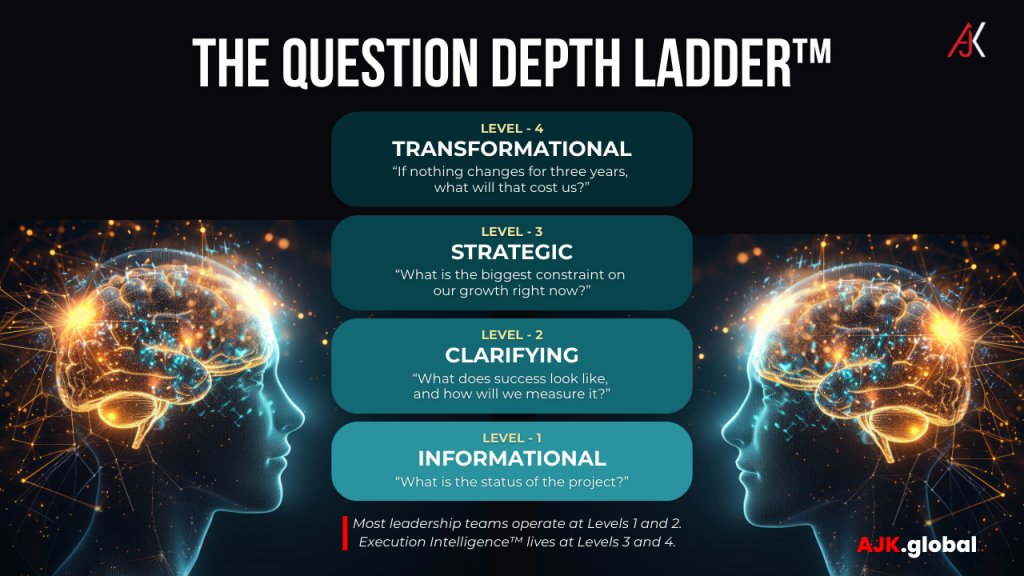
Not all questions are equal. One of the most useful tools inside the Execution Intelligence™ framework is the Question Depth Ladder™,a four-level model that helps leaders identify what kind of thinking their questions are producing.
Level 1: Informational “What is the status of this project?” These questions gather facts. They are necessary but not sufficient for strong executive decision-making. Over-reliance on Level 1 questions fills meetings with updates instead of outcomes.
Level 2: Clarifying “What does success look like, and how will we measure it?” These questions build shared understanding. They reduce ambiguity and improve alignment. Most organisations need more of these, but they are still not where transformation happens.
Level 3: Strategic “What is the single biggest constraint on our growth right now, and what would it take to remove it in the next 90 days?” These questions challenge assumptions, force prioritisation, and drive leadership accountability. This is where execution culture begins to shift.
Level 4: Transformational “If everything stayed exactly the same for the next three years, what would that cost us, and are we willing to pay it?” These are the rarest and most powerful questions. They reframe the conversation entirely. They surface uncomfortable truths. And they are the hallmark of organisations with genuine Execution Intelligence™.
Most leadership teams spend the majority of their meeting time at Levels 1 and 2. Closing the execution gap requires a deliberate move toward Levels 3 and 4.
The Strategic Power of Questions
Questions are not just communication tools. In the hands of a skilled leader, they are instruments of strategy. The right question at the right moment can unlock a decision worth millions, reveal a risk before it becomes a crisis, or shift an entire team’s direction in sixty seconds.
Here are seven strategic ways to deploy questions with intention:
- Discover information: “What is the one thing about this challenge no one has said out loud yet?”
- Confirm understanding: “So what you are telling me is…?”
- Build trust: “Is there anything you would prefer I do not raise in this conversation?”
- Create psychological safety: “When was the last time something at work made you genuinely laugh?”
- Signal your values: “What is one question you wish people would ask you, but they never do?”
- Drive strategic thinking: “If we knew we could not fail, what would we do differently this quarter?”
- Challenge the status quo: “What would we have to believe for this strategy to be completely wrong?”
The difference between organisations that survive and those that grow is often found not in their strategies, but in the quality of questions being asked across their leadership layers, in boardrooms, in team meetings, and in the conversations that never make it into the minutes.
The Execution Intelligence™ Shift
The move from $2 to $2,000 questions is not accidental. It is a deliberate shift in how a leadership team thinks, communicates, and decides. Below are three real question upgrades that show what this looks like in practice.
Question Upgrade 1
| ❌ Old Question | “Are we on track?” |
| Why it feels smart | It sounds like responsible oversight. Leaders feel like they are staying informed and managing risk. It seems efficient. |
| Why it kills clarity | It invites a yes or no answer. It gives the team an easy escape. It does not surface what is stuck, who owns what, or what needs to change. It creates the feeling of control without the substance of it. |
| ✅ New Question | “What is the single biggest thing slowing us down right now, and what do we need to remove it by tomorrow?” |
| Why it works | It forces specificity. It names a barrier. It sets a deadline. It demands a real answer rather than a comfortable one. |
| What changes culturally | Teams stop delivering polished status updates and start having honest conversations. Barriers get named and cleared instead of managed and hidden. Leadership execution accelerates. |
Question Upgrade 2
| ❌ Old Question | “Does everyone agree with this direction?” |
| Why it feels smart | It signals inclusive leadership. It appears to invite input and build consensus before moving forward. |
| Why it kills clarity | In most rooms, this produces nodding heads, not honest input. People rarely disagree publicly, especially with senior leaders present. This question manufactures the appearance of alignment without testing whether it is real. It is one of the primary reasons why strategies fail after launch. |
| ✅ New Question | “What is the strongest argument against this direction, and are we prepared for it?” |
| Why it works | It gives explicit permission to challenge. It invites critical thinking and surfaces risk before it becomes expensive. It separates genuine agreement from polite silence. |
| What changes culturally | Productive disagreement becomes a leadership norm rather than a threat. Strategies are pressure-tested before commitment. This is where real strategy implementation begins, not in the plan, but in the honest conversations that shape it. |
Question Upgrade 3
| ❌ Old Question | “How do we make sure this does not happen again?” |
| Why it feels smart | It sounds accountable. It signals that the leader is learning from mistakes and protecting the organisation from repeated failure. |
| Why it kills clarity | It is backward-facing. It drives energy toward preventing the past instead of building the future. It typically results in more processes, more sign-offs, and more friction, all of which slow organisational execution without resolving the root cause. |
| ✅ New Question | “What does this tell us about a gap in our system, and what is the simplest fix that lets us move faster next time?” |
| Why it works | It is still accountable, but it is forward-facing. It looks for a system improvement rather than a blame target. It asks for simplicity instead of adding complexity. |
| What changes culturally | Failure becomes useful data. Teams learn faster. Leaders stop adding layers of process and start removing friction. This is a core behaviour of organisations that are genuinely closing the execution gap. |
A Real-World Scenario: When the Questions Were Wrong, the Strategy Stalled
A retail and distribution company with just over 4,000 employees had experienced three consecutive years of flat revenue growth. The board approved a full strategy reset. Senior leaders engaged a respected consulting firm, and after four months of workshops, analysis, and stakeholder input, a bold new organisational strategy was ready. The presentation was sharp. The numbers were compelling. The all-staff launch event was met with genuine energy.
Six months later, almost nothing had changed.
An external execution review identified the root cause quickly. The strategy had not failed because it was wrong. It had failed because of the questions that were, and were not, being asked at every layer of the organisation.
In the boardroom, leaders were asking:
- “Has the strategy been communicated to all teams?”
- “Is everyone aligned?”
- “What does the strategy say we should prioritise?”
These are $2 questions dressed in corporate language. They feel strategic. They are not.
No one was asking:
- “Who in this building can describe our top three priorities in one sentence?”
- “Where is the gap between what we decided in this room and what is actually happening on the front line?”
- “What does a frontline manager need to hear, see, and experience to trust this strategy enough to act on it?”
The organisation had a communication plan. What it lacked was an execution intelligence culture.
The intervention was not another town hall or a revised strategy document. It was a targeted programme to teach leaders at every level to ask sharper, more specific, more honest questions, questions that closed the distance between strategic intent and daily action.
Within ninety days, three things shifted measurably:
- Weekly leadership meetings moved from status reporting to live problem-solving
- Frontline teams began surfacing blockers in real time rather than waiting for quarterly reviews
- Two major revenue initiatives that had been stalled for months were unblocked and launched
The strategy had not changed. The questions had. That is transformation leadership in practice.
How to Apply This With Your Leadership Team
You do not need a new framework, a consultant, or a two-day offsite to begin. You need intention and a starting point. Here are five practical steps your leadership team can take immediately:
- Step 1: Run a $2 Question Audit. Before your next leadership meeting, ask everyone to write down the three questions they most commonly raise. Review them together. Are these questions that drive decisions and build leadership accountability, or are they questions that could be answered by checking a document or asking a colleague? Name the $2 questions out loud. That act alone shifts the conversation.
- Step 2: Replace Your Standard Check-In. Most leaders open meetings with “Where are we up to?” Replace it with: “What is the one thing blocking progress right now, and who owns removing it?” This single change makes meetings faster, more honest, and more useful to your strategy implementation goals.
- Step 3: Introduce a Weekly High-Value Question. Each week, one leader prepares a single Level 3 or Level 4 question for the group to engage with. Rotate who sets it. Over time, this builds a culture of deeper thinking and stronger executive decision-making across the team.
- Step 4: Train Your Managers on Question Quality. Do not assume middle managers know how to ask high-value questions. Most were never taught. Run a focused sixty-minute session using real examples from your own organisation that shows the difference between a $2 question and a $2,000 one. Let managers practise upgrading their own most common questions. This is one of the fastest levers for improving organisational execution at scale.
- Step 5: Make Question Quality a Leadership Standard. Add a simple reflection to your leadership reviews: “Did the questions we asked this period drive decisions and action, or just conversation?” Recognise strong examples. When leaders see that question quality is valued and rewarded, they invest in developing it. That is how execution culture shifts from aspiration to practice.
Does Your Leadership Team Have a $2 Question Problem?
Before you move on, take sixty seconds to assess. These are five of the clearest signals that $2 questions have become embedded in your leadership culture:
- Meetings end without named owners. Actions are discussed but not assigned. Everyone leaves knowing what was said, but not what happens next, or who is responsible for it.
- Leaders ask “Are we aligned?” instead of “Where are we misaligned?” The first question invites comfort. The second invites honesty. If your team is consistently asking the first, real misalignment is almost certainly being missed.
- Status updates dominate meeting time. If the majority of your leadership meetings are spent reporting on what has happened rather than deciding what to do next, your execution culture is stuck at Level 1 of the Question Depth Ladder™.
- The same blockers appear repeatedly. If the same obstacles surface quarter after quarter, your team is describing problems but not asking the questions needed to solve them. This is a hallmark of poor strategy implementation and low leadership accountability.
- Teams wait for permission before acting. When people consistently hold back and wait to be told what to do, it is often because the questions asked of them have trained them to. High-ownership cultures are built by leaders who ask “What will you do?”, not “What do you think we should do?”
If two or more of these signals are present in your organisation, the good news is that all of them are addressable. And most of them start with a question.
Think Byte: This Week’s Challenge
In your next team meeting, open with this: “What are the $2 questions we keep asking and what should we be asking instead?”
Challenge your team to identify where low-value questions are consuming time and energy. Then upgrade them together. You do not need to change everything at once. One meeting. One better question. One shift in execution culture.
That is where closing the execution gap begins.
Frequently Asked Questions About Leadership Execution
What is Execution Intelligence™?
Execution Intelligence™ is a framework I developed that helps senior leaders convert strategy into action with speed, clarity, and accountability. It is built on the premise that most organisations do not fail because their strategy is wrong, they fail because of how leaders think, communicate, and decide during execution. A central pillar of Execution Intelligence™ is developing the discipline to ask high-value questions that surface real barriers, build ownership, and drive momentum. It is both a mindset and a measurable skill set that can be embedded into any leadership team or organisational culture.
Why do leaders struggle to execute strategy?
Research from McKinsey shows that fewer than 30% of organisational transformations succeed, with execution failure, not strategic error, identified as the primary cause. The most common reasons include: strategy that is not clearly understood by the people responsible for delivering it; no clear ownership at the point of implementation; decisions that take too long because the wrong questions are being asked; and an execution culture that rewards activity over outcomes. Closing the execution gap requires sharper questions, clearer accountability structures, and faster decision-making at every level of the organisation.
How do better questions improve performance?
Better questions produce better focus. When a leader asks “What is blocking us right now?” instead of “Is everything okay?”, they receive specific, actionable answers. Specific answers lead to better decisions. Better decisions drive faster action. Faster action produces better results. The quality of questions being asked in your weekly meetings is one of the most reliable indicators of your organisation’s execution health. If the questions are vague and surface-level, the decisions, and the results, will reflect that.
Can execution be trained?
Yes. Execution is not a fixed personality trait, it is a set of skills, habits, and cultural norms that can be developed deliberately. Leaders can be trained to ask better questions, make faster decisions, run more effective meetings, and build environments where action is the default rather than the exception. My Execution Intelligence™ workshops are designed specifically for senior teams who want to close the execution gap and build the execution culture their strategy deserves. Like any capability, it strengthens with practice, structure, and the right environment.
What is the difference between strategy and execution?
Strategy is the plan. Execution is what actually happens. Many organisations invest heavily in building strategies and very little in building the execution capability to deliver them. The gap between the two is where most growth opportunities are lost, and where significant financial value quietly disappears. Closing the execution gap is not about working harder or adding more process. It is about building a leadership culture where sharp questions, clear decisions, and strong accountability are daily habits, not annual commitments.
How do I know if my leadership team has an execution problem?
The clearest signals include meetings that end without clear actions or owners; strategies that are launched but never fully delivered; the same problems appearing in review after review; and leaders who spend more time reporting on progress than driving it. If your team consistently asks $2 questions in high-stakes moments, and accepts comfortable non-answers in return, that is a strong signal that your organisational execution culture needs deliberate attention.
What is the fastest way to start closing the execution gap?
Start with your questions. Audit the questions your leadership team asks most often. Identify which are $2 questions, vague, low-value, and easily answered elsewhere. Then replace them, deliberately, with questions from the upper levels of the Question Depth Ladder™. This shift does not require a new strategy or a new structure. It requires a new standard for how your leadership team thinks and communicates. You can begin in your next meeting.
Closing
Execution Intelligence™ keynotes and leadership workshops are designed for senior teams ready to move from strategy to measurable momentum. If that is your agenda this year, let’s talk.
This framework forms part of AJ Kulatunga’s Execution Intelligence™ keynote and leadership workshops designed for senior teams navigating complexity and growth.
Hat tip to Morgan Housel for the concept of $3 questions, who credits Ramit Sethi. Both apply it to personal finance, but I choose to apply it to leadership execution, where the stakes are considerably higher.
If this gave you something useful, share it. The best ideas only create value when they move.
