
Resistance to Change:WHY IT HARDENS BEFORE GO-LIVE AND HOW TO MOVE FIRST
Resistance to change forms in the days after a decision, not at go-live. Learn the First 48 Hours method to move the willing before doubt sets in.
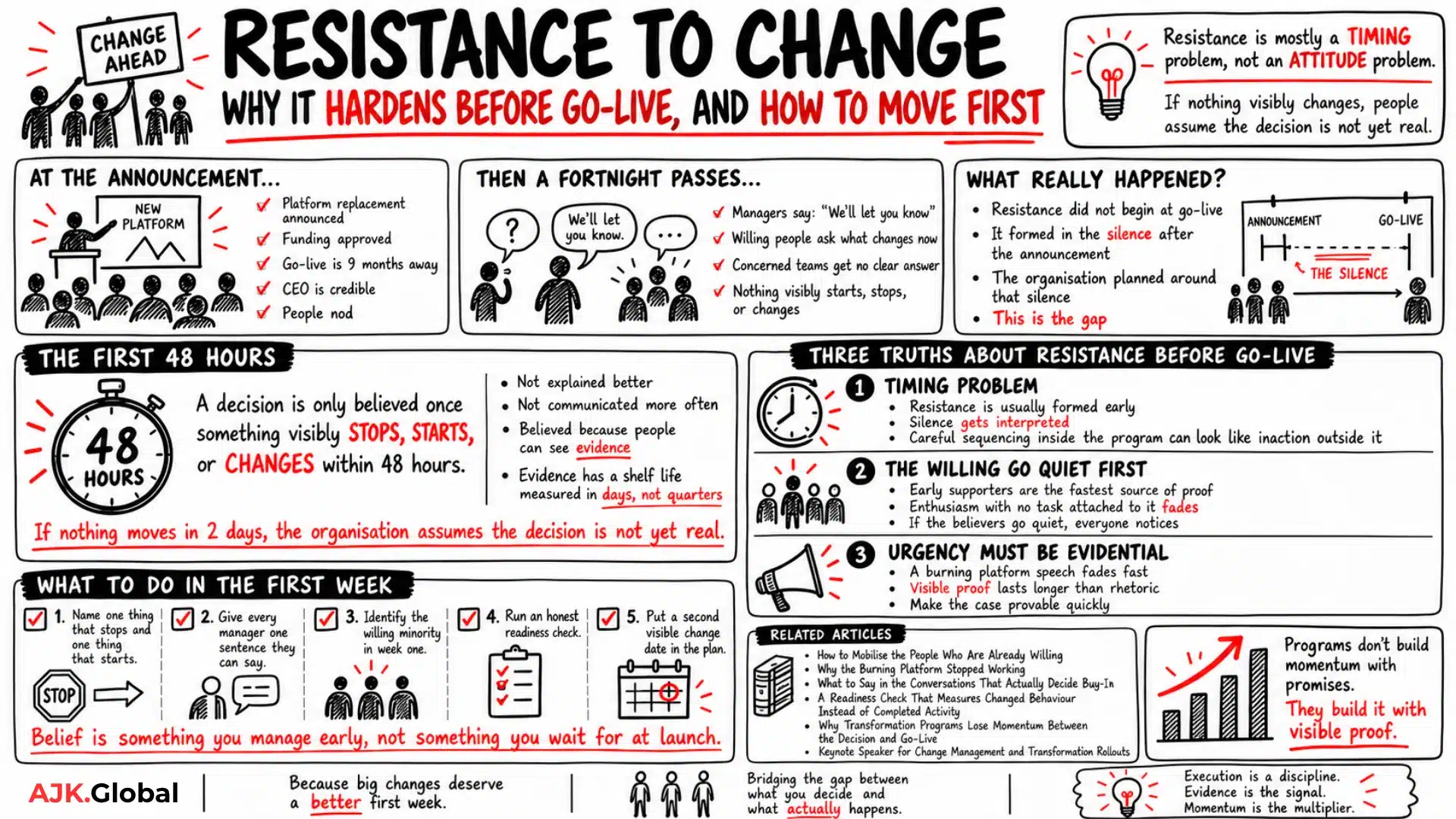
Most advice on resistance to change treats it as an attitude to be managed: identify the resisters, message around them, wait for the adoption curve to do its work. If you are a transformation director, CIO, COO, CHRO or program sponsor staring down a dated go-live, that advice is not wrong so much as too late. By the time resistance is visible enough to manage, it has already hardened, and it hardened weeks before anyone on the program thought to look for it. This article makes a different argument: resistance to change is mostly a timing problem, not an attitude problem, and the highest-leverage work in any transformation or technology rollout happens in the first days after the decision, not in the months of planning before go-live. Get that window right and you are not overcoming resistance to change in the workplace after the fact. You are building momentum before resistance has anywhere to take hold.
Resistance to Change Is a Timing Problem, Not an Attitude Problem
The standard model of resistance assumes a population that needs to be won over: segment the resisters, understand their objections, communicate at them until they come around. There is real psychology behind why people hold on to old ways of working. Harvard Business Review’s research on why people resist changing behaviour, even when they genuinely want to, makes a strong case that resistance is often a hidden competing commitment rather than stubbornness. That research is worth reading. It is also, for a program with a go-live date in nine months, close to unactionable. You cannot run individual psychology on four thousand employees before your build phase ends.
What you can do something about is what the organisation experiences in the days after a decision is made public. Most program teams do not create resistance through arrogance or poor explanation. They create it by being careful: modelling the rollout properly, sequencing the build, protecting the go-live date from scope creep. Careful looks responsible from inside the program. From outside it, careful looks like silence, and silence is not neutral. An organisation that hears a decision and then sees nothing happen does not conclude that the program is being diligent. It concludes that the decision was not really real, and it starts planning around that conclusion. That is the shift this article asks you to make: stop treating resistance as something to overcome later and start treating it as something that forms, or does not, in a window you control early.
This reframing matters commercially, not just conceptually. A program that treats resistance as an attitude problem budgets for it as a communications workstream: town halls, FAQs, a change network that meets monthly. A program that treats resistance as a timing problem budgets for it as a sequencing decision, made once, in the first fortnight, and then defended for the life of the rollout. The second version is cheaper, because it spends effort while movement is still cheap, before positions have set. The first version is more expensive, because by the time it engages seriously, usually well into the build phase, it is not introducing a change to a neutral organisation. It is arguing with a position the organisation already holds. Reducing resistance to organisational change, in other words, is mostly a scheduling decision dressed up as a communications problem.
What Actually Happens in the Weeks After the Announcement
Picture the shape this takes in the kinds of rooms AJ is often brought into. An enterprise announces a platform replacement at an all-staff town hall. The decision is real. The funding is signed. The go-live is nine months out. The announcement itself lands well: the CEO is credible, the reasoning is sound, people nod. Then, for a fortnight, nothing visibly changes.
The people who were ready to move ask their manager what they should do differently on Monday. “We’ll let you know,” their manager says, because their manager does not know either. The people with genuine, reasonable concerns ask what happens to their team’s process once the new system lands. They get the same answer. By the third week, the willing have gone quiet, because enthusiasm with nowhere to go is embarrassing to keep showing, and nobody wants to be the person still asking. The sceptics, meanwhile, now have a story that fits everything they have seen before: this is another one of those. Someone says it out loud in a team meeting, and nobody corrects them, because nothing has happened yet to correct them with.
Resistance did not form at go-live. It formed in that fortnight of silence after the announcement, and it hardened while the program team was still writing its plan. This is the pattern underneath most of what gets labelled “change resistant culture.” It is rarely the culture. It is the gap.
The First 48 Hours: Why a Decision Is Only Believed When Something Visibly Changes
The mechanism behind this pattern has a name in AJ’s work: The First 48 Hours. A decision is only believed when something visibly stops, starts or changes within 48 hours of it being made. Not explained better. Not communicated more often. Visibly, observably different, inside two days. Belief in an organisation is not built by the quality of the announcement. It is built by evidence that the announcement was true, and evidence has a shelf life measured in days, not quarters.
The First 48 Hours applies to a rollout in three ways. First, at the moment of announcement: name one thing that stops and one thing that starts this week, however small, so the decision is evidenced rather than asserted. A retired report, a paused approval step, a meeting that no longer needs to happen, a new one that does. Second, at every subsequent program milestone: treat the same 48 hour discipline as ongoing rather than a one-off, because belief decays continuously, not just once at launch. A steering committee sign-off, a phase gate, a pilot result: each is a fresh moment where the organisation is deciding whether to keep believing you. Third, as a diagnostic you can run on your own program right now: ask what visibly changed in the 48 hours after your steering committee approved the business case. If the honest answer is “nothing, we went away and planned,” you have just found the source of resistance the program will later, wrongly, attribute to culture.
Why the Willing Go Quiet First
The costliest part of the silence is not what it does to the sceptics. Sceptics were always going to need convincing, and a good program budgets for that. The costliest part is what it does to the people who arrived already on side. Every organisation about to change contains a minority who want it to happen, often because they built a workaround years ago for the exact problem the program is now solving properly. That minority is your fastest source of visible proof, and it is the group most programs waste first.
Enthusiasm with no task attached to it does not sit patiently. When nothing happens for a fortnight, the people who told their team this was going to be good are the ones left looking foolish, not the sceptics. A program that finds its early adopters early and gives them one small, real thing to do this week converts that willingness into evidence the whole organisation can see. A program that finds them in month four, names them “champions” and hands them a lanyard has already spent the asset it most needed. This is worth designing for deliberately, and it is covered in full in how to mobilise the people who are already willing, including how to give them something to do before go-live even starts.
There is a second, quieter cost to losing the willing first. Every organisation reads its own signals for what a change is really worth, and the fastest signal available is watching what happens to the people who said yes early. If the visibly enthusiastic go quiet within a month, the rest of the organisation reads that as information: even the believers stopped believing. That reading spreads faster than any official communication, because it is peer evidence rather than program messaging, and peer evidence is what people actually trust. Protecting the willing in the first weeks is not a nicety. It is protecting the one signal the rest of the organisation is going to use to decide whether this rollout is real.
How to Create Urgency Before Change Hardens Into Resistance
The instinctive fix here is a bigger case for urgency: a burning platform slide, a competitor threat, a cost-of-inaction number. In an organisation on its second or third major program in five years, this tends to backfire. A crisis framing lands as recognition rather than motivation, because the room has seen this framing before and the organisation is still here, which quietly teaches everyone that “urgent” means “important to someone above me.” The full argument for why this specific tactic stops working, and what a leader says instead to a room that has already heard it, is set out in why the burning platform stopped working.
The more durable form of urgency is not rhetorical, it is evidential. Urgency built on a slide has to be renewed every time someone forgets the numbers. Urgency built on something the organisation can already see, a process that changed last week, a decision that was kept, does not need renewing, because it is not a claim anymore. It is a fact people walk past on the way to their desk. Creating urgency before change hardens into resistance is less about the size of the case you make and more about how quickly you make the case provable.
What to Do in the First Week After the Decision
None of this requires the build to be finished, or even started. It requires the program to treat the first week as a deliverable in its own right, alongside the technical plan.
- Name one thing that stops and one thing that starts, publicly, within the first 48 hours. It does not need to be the core system. It needs to be true and visible.
- Give every manager one sentence they can say without notes. Not a slide deck to relay. A single honest answer to “what does this mean for my team this month,” covered in full in what to say in the conversations that actually decide buy-in.
- Identify your willing minority in week one, not month four, and hand each of them a specific, dated task they can complete by Friday.
- Run an honest readiness check with the teams most affected, not a completion tracker for the program’s own activity. The method for that is in a readiness check that measures changed behaviour instead of completed activity.
- Put a second date in the plan for the next visible change, so the organisation is never more than a few weeks from the next piece of evidence.
None of these five moves require the technology to be ready. They require the program to decide, before go-live, that belief is something it is actively managing rather than something it expects to arrive on launch day.
What This Looks Like When It Works
Contrast the fortnight of silence with a program that treats the first week deliberately. The decision is announced on a Tuesday. By Thursday, one specific approval step that used to take three days now takes one, and the team affected knows exactly why, because their manager told them and could say it without reading from a slide. A dozen people who had been quietly frustrated with the old process for years hear about it and ask how to get involved. Three of them are given a small, real piece of the pilot the following week. Nobody has been convinced of anything with a speech. They have watched something be true.
By week three, when the inevitable sceptical question arrives in a team meeting (“didn’t we try something like this before?”), someone in the room has an answer that is not a promise. They point at the thing that already changed. That is the entire difference between a program that spends its first quarter fighting resistance it built itself and one that spends its first quarter converting attention into ownership.
Bringing This Into Your Program
Most transformation and technology rollouts, ERP replacements, CRM migrations, core-system changes, new operating models, are sequenced for delivery logic: foundations first, visible change later. That sequencing is correct engineering and, on its own, poor psychology. It is also the structural reason the fortnight of silence happens in the first place, because the roadmap itself has not scheduled anything for the organisation to see. The deeper diagnosis of that problem, and how to sequence a roadmap for evidence as well as delivery, is covered in why transformation programs lose momentum between the decision and go-live.
Execution Intelligence™ is the gap between what an organisation decides and what it actually does. On a rollout, the gap opens in exactly the window this article has been describing, and it opens quietly: no argument, no visible resistance, just an organisation waiting to see whether the decision was real. Closing it is not a communications task bolted on to the program plan. It is a discipline the program sponsor and the senior team have to run deliberately, starting on day one, and it is considerably cheaper to run early than it is to run as damage control in month six.
This is also where an outside voice does something an internal program update cannot. A steering committee member or PMO lead delivering the case for urgency, however well they make it, is heard as a person defending their own program. A senior-level challenge delivered at the kickoff, framed around the cost of the first quiet weeks and what to do about them, lands differently, and it gives the leadership team shared language to carry into the fortnight that follows. If you are weighing what format actually helps at this stage of a program, from a kickoff keynote through to a working session for your champions cohort, the format guidance on keynote speaker for change management and transformation rollouts is built to help you decide.
If you have a go-live date on the calendar and a program kickoff still to design, the highest-value moment you have is earlier than most sponsors think. Get the room moving before the silence sets in, and resistance never has the quiet it needs to organise. Check AJ’s availability for your program kickoff and talk through what the first week of your rollout should actually look like.
AJ Kulatunga is a keynote speaker on Execution Intelligence™, working with transformation directors, CIOs, COOs and program sponsors to close the gap between a transformation decision and an organisation that actually believes it. The First 48 Hours is his mechanism for the part of a rollout most program plans leave unmanaged: the weeks between a decision being announced and anything visibly changing.

About The Author:
AJ Kulatunga
AJ Kulatunga is a Melbourne-based keynote speaker on Execution Intelligence™: the gap between what organisations decide and what they actually do, and how leaders close it. He works with executive teams, ELTs and boards at leadership off-sites and strategy days, where entrenched thinking has to move before the big decisions do. Since starting his first business at age seven and being named NT Young Achiever of the Year in 2008, his work has been built around one question: what actually happens to ideas inside organisations.