
WHY CROSS-FUNCTIONAL WORK STALLS… EVEN WHEN EVERYONE IS DOING THEIR JOB
Resistance to change forms in the days after a decision, not at go-live. Learn the First 48 Hours method to move the willing before doubt sets in.
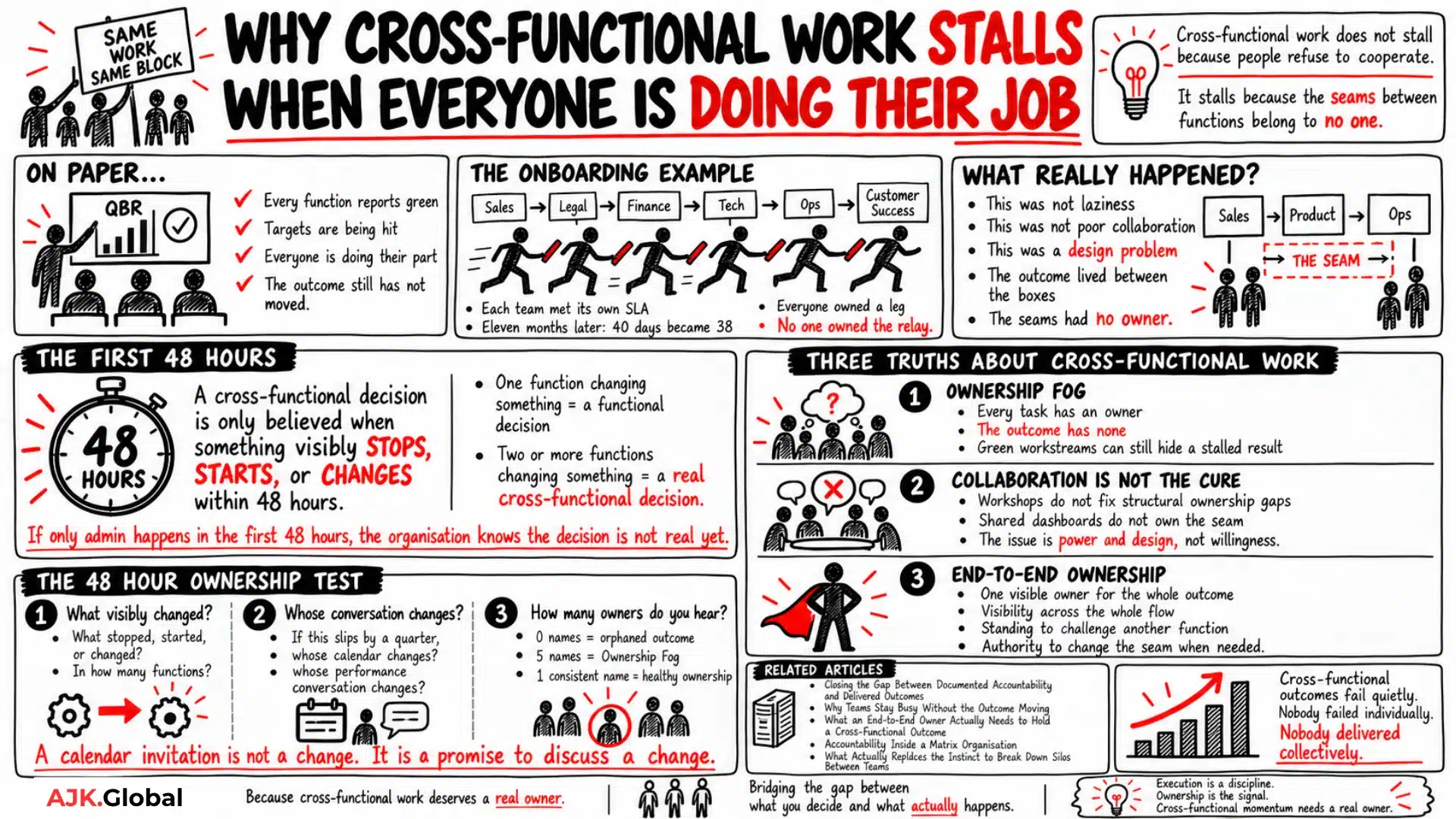
The most expensive mistakes in a business rarely look like mistakes. They look like everyone doing their job properly. That’s the real answer to why cross-functional work stalls inside companies that look, on paper, like they’re running well: give six competent people six clearly defined jobs, and every one of them can succeed while the thing the business actually needed still doesn’t happen. Nobody’s lazy. Nobody’s plotting against anyone. If your instinct here is “we need better communication,” hold that thought, it’s the instinct that’s already cost you the last eleven months and the workshop budget that went with it.
Picture a CFO staring at her dashboard on a Friday afternoon: every function hit its number this quarter, Legal turned contracts around in two days, Finance cleared credit checks in three, Technology provisioned in five, and the one number the whole leadership team agreed actually mattered still hasn’t moved. I see a version of that Friday constantly, in the rooms I get invited into: the CEO, the COO, the CHRO, the CFO, the chief transformation officer and the chiefs of staff around the table, each able to point to a quarterly business review where every function reported green and the outcome still didn’t move. This isn’t laziness, conflict, or a communication failure another workshop will fix. It’s a design problem, and it’s the clearest example I know of Execution Intelligence™, the gap between what organisations decide and what they actually do. Cross-functional work is where that gap shows up first, because it’s where a decision has to survive contact with more than one function at once.
Cross-Functional Work Does Not Stall Because People Refuse to Cooperate
The standard diagnosis for stalled cross-functional work is a collaboration problem, and the standard remedy follows from it: a workshop, a shared workspace, a team-building day, one more dashboard that lights up green across the top and tells you nothing about the outcome underneath it. None of that is wrong, exactly. It is aimed at the wrong target.
I want to be precise that I am not saying the people in these organisations are difficult, political or disengaged. In the vast majority of cases I see, the opposite is true. Every function leader is competent and is cooperating in every practical sense: they turn up to the steering committee, they answer the emails, they nominate someone when asked. Nobody is confused about the goal. Nobody is refusing to help. That is precisely what makes the problem hard to see, and hard to fix with collaboration tools. If the issue were refusal, more collaboration would solve it. But you cannot collaborate your way out of a problem that was never about willingness.
The organisation was designed as a set of functions, each measured on its own outputs, and then asked to produce outcomes that run across all of them. The functional boxes get owners, budgets and performance conversations. The space between the boxes, where the outcome actually lives, gets none of that. Functional leaders do not protect their own scope because they are territorial. They protect it because it is the only thing they are measured on, and measurement is a promise about what will be noticed.
Ask any leader to choose between the number in their own performance review and a cross-functional outcome that appears in nobody’s, and you already know which one wins, every time, without a single person behaving badly.
Everyone Owned a Leg. No One Owned the Relay.
Imagine a leadership team looking at customer onboarding and deciding, correctly and unanimously, that it takes too long: forty days from signed contract to a customer actually using what they bought. Nobody argues, nobody resists, and the target goes on the plan: get it to ten.
Onboarding crosses six functions. Sales owns the contract, Legal owns the terms, Finance owns the credit check, Technology owns provisioning, Operations owns the physical setup, Customer Success owns the handover. Each function nominates a workstream lead, a steering committee is scheduled fortnightly, and a dashboard is built, because a dashboard is what organisations build when they want to feel like they are managing something.
Eleven months later it takes thirty-eight days.
The part most leadership teams skip past on their way to being frustrated with each other is that every function met its own service level. Legal turned contracts around inside its two-day standard. Finance cleared credit checks inside three. Technology provisioned inside five. Not one of those six leaders failed; every one of them can prove, with data, that they did their job. And the customer waited thirty-eight days anyway.
The two days that mattered most were never anybody’s: the contract sitting in a queue because Legal did not know Finance was waiting, the provisioning request that could not start until someone noticed the credit check had cleared. Six functions, five seams between them, and not one of those seams belonged to a named person. Everyone owned a leg. No one owned the relay.
Nobody failed, and nobody delivered.
The outcome didn’t stall because anyone dropped the ball. It stalled because the ball was never actually in anyone’s hands. It was in the space between them, and there is no service level for that.
Ownership Fog: When Every Task Has an Owner and the Outcome Has None
I use a specific term for this, because vague language lets it hide. Ownership Fog is the condition where every task in a cross-functional initiative has a named owner and the outcome itself has none.
This is different from a lack of accountability, and the difference matters, because leadership teams reach for that phrase and it sends them looking in the wrong place. A lack of accountability suggests someone is dodging a duty they already hold. Ownership Fog is quieter and more structural: no one is dodging anything, because the duty for the whole outcome was never assigned to anyone. You cannot hold a person accountable for a job that was never theirs. The six workstream leads in the onboarding example were entirely accountable for their own legs of the relay; the relay itself, the number the customer actually experiences, belonged to nobody. That is an ownership gap sitting underneath six perfectly functional accountability structures, not an accountability gap in the usual sense.
The tell is always the same: a RACI with six names on it, a project plan with a hundred tasks and a hundred owners, a dashboard with every workstream green, and an outcome that has not moved. A complete RACI is not the same as an owned outcome; I go further into why a fully populated RACI still leaves the actual result unowned in the piece on closing the gap between documented accountability and delivered outcomes.
Why We Keep Diagnosing This as a Collaboration Problem
There is a reason organisations keep reaching for the collaboration remedy even after it fails, and it is not stupidity. Collaboration problems are comfortable to diagnose because they do not implicate the org chart. A shared workspace or a joint workshop asks nothing of anyone’s authority; it asks people to be nicer to each other across a boundary the structure itself created. Naming an ownership gap is less comfortable, because the honest fix means giving one person authority over decisions that currently sit inside someone else’s function, and that is a conversation about power, not etiquette.
This is also where diffusion of responsibility does its real damage, not just in the classic social psychology experiments about bystanders on a street. When responsibility for an outcome is spread across six capable people, each one reasonably assumes someone else is closer to the whole picture, while being fully occupied doing their own job well.
A recent analysis of workplace accountability makes the same point from the practitioner side: distributing responsibility across a group, without a single accountable owner, tends to produce less accountability overall, because everyone can point to someone else’s piece of the work when the whole thing slips (SHRM, “Why Too Many Shared Responsibilities Lead to Less Accountability”). Whole-outcome thinking, looking at the customer’s thirty-eight days rather than any single function’s service level, is not natural inside an organisation built from functional boxes. It has to be deliberately assigned, or it will not happen on its own.
The First 48 Hours: What Has to Change, and in How Many Functions
This is where I use a mechanism I bring into most rooms I work in, because it turns a slippery diagnosis into something a leadership team can test in real time. I call it The First 48 Hours: a decision is only believed when something visibly stops, starts or changes in the first 48 hours after it is made. For cross-functional work specifically, the mechanism sharpens into one useful distinction. If one function changes something inside the first 48 hours, that was a functional decision. If two or more functions change something inside that window, that was a genuine cross-functional decision. That distinction is the whole test, and it costs nothing to apply: it is not asking anyone’s opinion, it is asking what actually happened in two days of calendars and workflows.
Go back to the onboarding example and apply it honestly. What visibly stopped, started or changed in the 48 hours after the leadership team agreed the forty-day target had to come down? A project was created. A steering committee was scheduled. Six workstream leads were nominated. That is the most common failure I see, named plainly: in the first 48 hours after most cross-functional commitments, the only things that happen are administrative. Nothing stopped. Nothing started. Nothing changed in a single person’s actual week. A calendar invitation is not a change, it is a promise to discuss a change.
That first 48 hours told the organisation everything it needed to know about how real the onboarding target was, and the organisation behaved accordingly for the next eleven months. I look at that earlier failure point, where activity is high and nothing is actually moving before anyone even calls it stalled, in the piece on why teams stay busy without the outcome moving.
The 48 Hour Ownership Test
Because the distinction above is easy to apply loosely, I give leadership teams a sharper version of it: the 48 Hour Ownership Test. Take any cross-functional commitment made last quarter, one that hasn’t visibly delivered, and ask three questions.
First, what visibly stopped, started or changed in the 48 hours after it was agreed, and in how many functions? A project code being opened in a system does not count. A person’s actual Tuesday looking different does.
Second, if this outcome slips by a quarter, whose calendar changes and whose performance conversation changes? Not whose dashboard turns amber. Whose actual conversation with their own manager becomes different because of the slip.
Third, if you asked five leaders who owns this outcome, how many names would you get back? Each answer means something specific. Zero names means the outcome is orphaned; nobody believes it is theirs, and it will drift until someone is forced to claim it under pressure. Five different names is Ownership Fog: everyone can point to a piece, and the whole thing still belongs to no one. One consistent name, given by all five without hesitation, is the rare healthy answer.
I have watched this test take less than ten minutes in a leadership team meeting and produce more honest movement than a quarter of steering committee updates, because it does not ask anyone to admit fault. It just asks the organisation to describe what actually happened.
If This Fails Quietly, Who Loses Something?
There is a shorter version of the same test a leader can use on the spot, in a corridor, without needing a workshop to run it: if this outcome quietly fails, who loses something? Not who gets blamed in a review. Who actually loses something, a bonus, a budget line, a piece of scope, a credibility they were relying on. If the honest answer is “everyone a bit, nobody much,” the outcome has no owner, regardless of what the project plan says or how complete the RACI looks. This is the empty chair question, and it works as a gut check rather than a formal audit, because gut checks travel faster through an organisation than frameworks do. If nobody in the room can immediately answer whose loss it would be, you have just found your next Ownership Fog outcome, in under a minute.
What End-to-End Ownership Actually Requires
What does end-to-end ownership actually require, so it is real rather than decorative? An end-to-end owner needs three things a workstream lead, by definition, does not have. First, visibility across the whole outcome, not just their own function’s slice of it, so they can see the seam between Legal and Finance even though they sit in neither team. Second, the standing to raise a problem inside a function that does not report to them, as a normal, expected act rather than one that gets quietly resented afterwards. Third, and this is the one organisations resist most, the authority to change what happens inside another function’s process when the outcome requires it: to ask Legal to release a contract before its own two-day window closes if Finance is already sitting ready, without that being treated as Legal being managed from outside Legal.
That third requirement is where most organisations flinch, because it looks like it erodes functional authority. It does not: functional authority was never designed to cover the seams between functions, so nothing is being taken away, only created. I go further into what this ownership needs to survive a real quarter in the piece on what an end-to-end owner actually needs to hold a cross-functional outcome. Where this tends to break down for people who report into a function and a program at once, I cover in the piece on accountability inside a matrix organisation. And because “silos” is usually the wrong word for what leadership teams are pointing at, I unpack why in the piece on what actually replaces the instinct to break down silos between teams. None of this happens through goodwill alone, and it usually sits underneath a strategy that has already had to travel down through its own layers to reach these functions, a related problem I address in the piece on how strategy actually moves through an organisation’s layers.
Where to Start This Week
You do not need a redesign to start. You need one outcome and one honest test. Pick the cross-functional commitment your leadership team is least confident about, the one that got a polite nod in the last quarterly business review and nothing more. Run the 48 Hour Ownership Test on it this week, out loud, in the room, with the people who would actually know the answers.
Then ask the empty chair question about the same outcome. If the two tests agree, that is Ownership Fog, however tidy the plan looks on paper. Assign one name to the whole outcome, give that person the three things an end-to-end owner needs, and watch what changes inside 48 hours. If nothing visibly stops, starts or changes in more than one function inside that window, you have not made the decision yet. You have scheduled a conversation about making it.
Bringing This Into the Room
There is a reason I get called into a room rather than an organisation solving this quietly on its own, and it is not that the people inside it lack the insight. Most of the leaders I sit across from already sense exactly where their Ownership Fog is. What they cannot do is say it out loud, in a room full of the other functional leaders at once, without it landing as blame directed at whoever is sitting closest to the gap.
That is precisely the moment a CEO, COO, CHRO or chief transformation officer with a leadership conference, an all-leaders forum or a functional leader day in the diary should bring an external voice into the room. Naming the pattern once, in front of everyone, from someone not competing for the same budget or the same performance review, costs a single session. Resolving the same misunderstanding six times, in six separate one-to-ones after the fact, costs a quarter, and usually some trust along the way as well.
If you recognise your organisation somewhere in this piece, the way I speak to this is on the accountability and ownership keynote page, and you can check dates directly at the booking page.

About The Author:
AJ Kulatunga
AJ Kulatunga is an award-winning Business Strategist and Global Keynote Speaker specialising in Execution Intelligence™ – turning ambitious ideas into action through better decisions, clearer ownership and sustained momentum across organisations. He works with executive teams and boards at leadership offsites and strategy days, challenging the assumptions and organisational friction that allow every function to succeed while the bigger outcome stands still. An entrepreneur since age seven and NT Young Achiever of the Year in 2008, AJ brings a founder’s perspective to a deceptively simple question: when everyone owns their piece, who owns the result?